

Bird of the Week: Piping Plover
As we cruise toward the back half of summer, let’s give it up for this miraculous little beach bird.

I can’t lie to you, my fellow bird freaks. When I was considering which bird to highlight this week, I looked through my ever-expanding list of birds I’d like to cover in BOTW and marveled. There are some real gasp-worthy specimens on there, let me tell you. Birds with psychedelic coloring, unreal halos of feathers, and faces you would not believe. I can’t wait to roll those out at some point in the future.
For today, though, I opted for a more understated, but still incredible creature. It’s one we’ve actually shouted out before in a roundup of recommendations from you. It was nominated by reader Helen Bolton, who put it best, writing, “it's a good bird.” Say no more!! Actually, do say more, or rather I want to say more, which is why this bird is getting its own post.
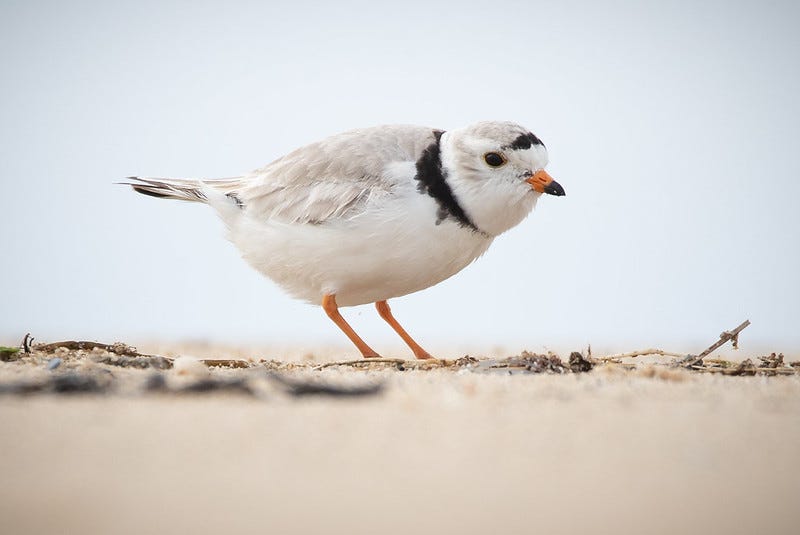
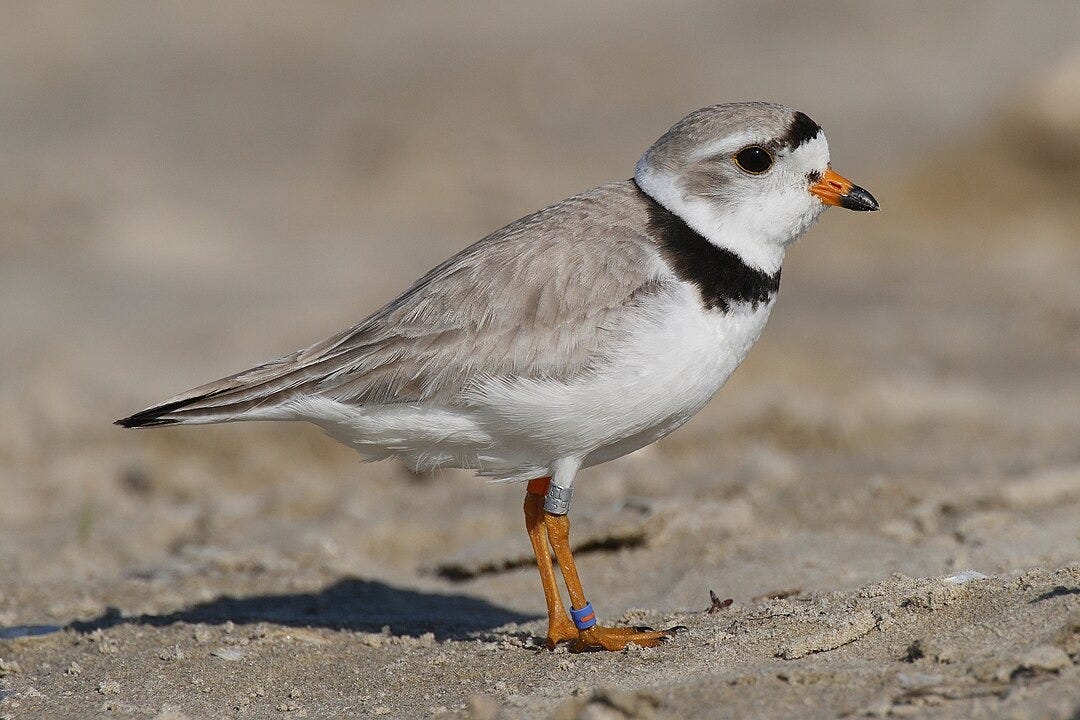
This week, we’re talking about the absolutely perfect piping plover. Hello beautiful!
(This bird also made it into a round of Fowl Hysteria but lost by the barb of a feather to the shoebill, which is honestly pretty impressive because the shoebill is a beast.)
The piping plover is indeed a good bird, and it’s a SUMMER bird. It’s a shorebird that nests and feeds in sand, and flocks to the beach during the late spring and summer months to breed. Plovers even return to the same locations year after year, both to breed and to spend their winters, not unlike human snowbirds. Smart and efficient! They know what they like. If you’ve been on a beach in the northeast U.S. during the warm months, you’ve probably seen one!
There are actually two subspecies of piping plovers, as the eastern and Midwest populations are distinct. We’re focusing on the midwesterners today, and specifically the Great Lakes piping plover cohort because 1) I’m a Michigander and 2) I became obsessed with these guys after reading a piece shared by Nicolas Gonzalez of the Audubon Society:
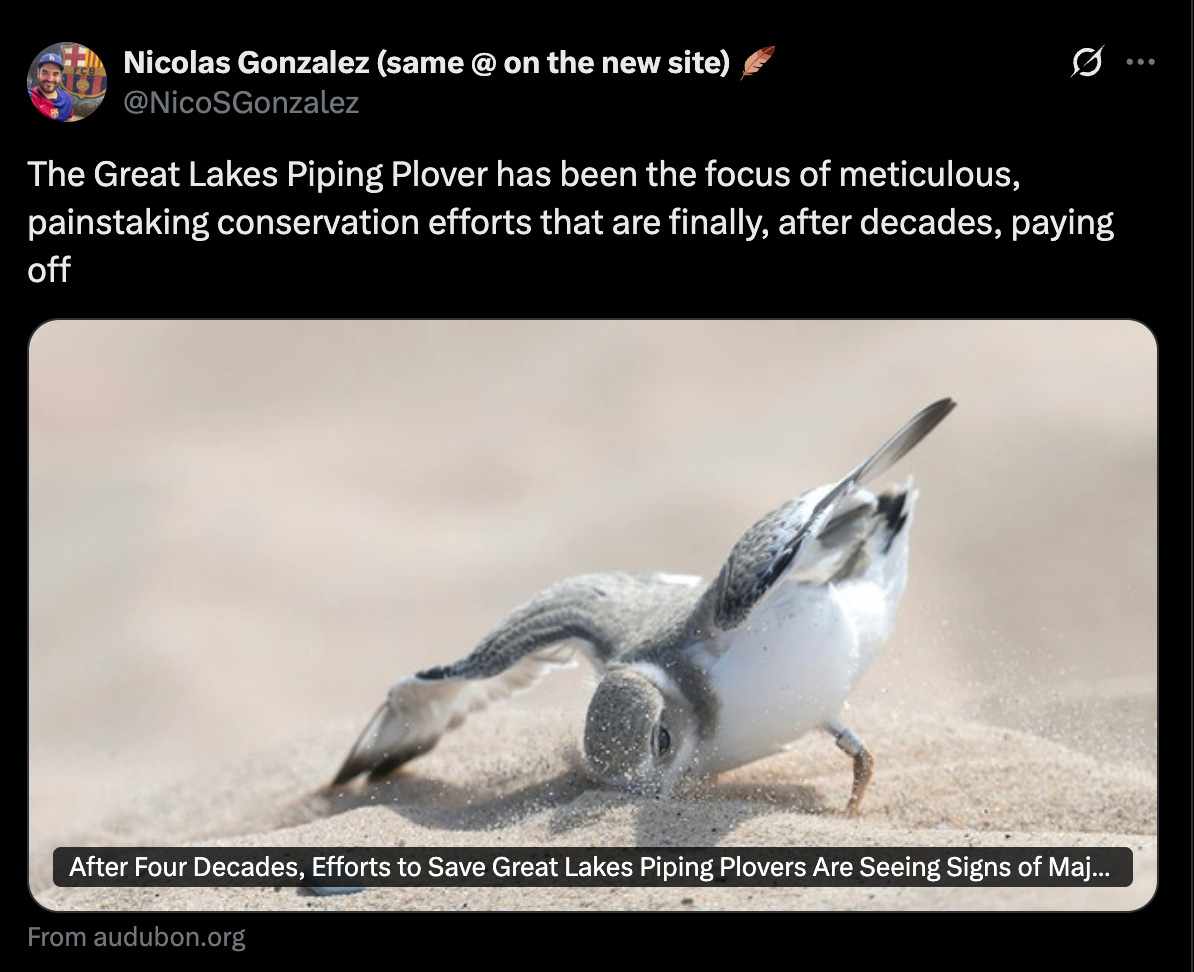
This story is amazing. Great Lakes piping plovers were declared endangered in the ‘80s, and in the decades since, conservationists have put in a stunning amount of work that is finally yielding results: The plover population went from just 12 plover pairs along the Great Lakes at its lowest point to 85, a record breeding number that was just hit in 2025.
These caretakers have toiled for years, going to lengths like using Elmer’s glue to carefully patch eggs to ensure survival, and the Great Lakes piping plover population is at last rebounding. There’s still a long way to go to get out of endangered status and plenty of threats to thwart the effort, but this story hit me hard when I read it.
From Audubon:
Around the Great Lakes, volunteer and professional monitors are the heart of the recovery program. They identify nest sites, erect protective fencing, rescue abandoned eggs, and educate members of the public—their spotting scopes tend to draw curious beachgoers—about the importance of keeping dogs on-leash and giving the birds space to raise their young. “Every year I’m blown away by how much affection and love they have for these birds,” says Tamima Itani, the lead volunteer coordinator in Chicago. “The monitors do everything they can to protect the plovers and their nests.”
A lot of people needed to care a lot about these birds and clock many thankless hours to get to this place. As bird populations are declining at rapid rates across the planet and the world at large feels like a storm of uncontrollable chaos and evil, this small victory feels big. It’s heartening, edifying, and motivating.
Plus, my god, these birds are cute as hell. Protect my round boys at all costs and please tune into this clip for the RUNNING. These little guys can really take off when they need to:
The piping plover’s name sounds like it should be part of a tongue twister, but the origin is much friendlier to the ears. It’s from their lovely calls, which consist of clear, high-pitched peeps and whistles.
Bird lovers spend a lot of time admiring the often ostentatious mating rituals of these members of the animal kingdom. Truly, no one knows how to be proudly horny like a male bird. But the plover mating ritual might be one of my favorites because it’s actually quite restrained and straightforward. Males will simply dig a hole in the sand and show it to the object of their affection to see if it’s good enough for her. If she approves of the hole, they’ll do the deed. Fair enough! What more do you need from a man?
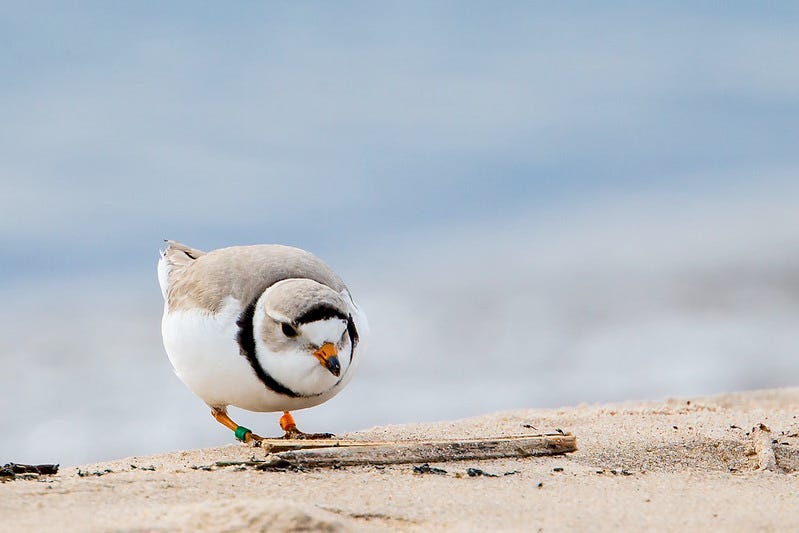
I hope these short kings with their delicate ink blot features are having a great summer. They deserve it.

As always, you can check out our complete Bird of the Week list here. Have a bird to nominate? Reach out to us at hello@discourseblog.com.
YES! What absolutely delightful birds.
Many years ago, my spouse and I volunteered to help with some bird banding out on Long Island where black skimmers and American oystercatchers frequently nest (and, sometimes, piping plovers). We mostly helped corral young birds while the experienced and trained folks took care of handling and banding the birds.
At one point, there were about 6 of us full-grown human adults trying to corral one wily American oystercatcher fledging when a whole mass of kindergarten or 1st grade aged kids comes marching over the dune as part of a summer camp group. The counselor leading them saw us, quickly assessed the situation, and turned to stop the march of the kids with a few well chosen words that were soon repeated in the near unison by a dozen or so children with no volume control:
"PIPING PLOVER ALERT! PIPING PLOVER ALERT!"
I still hear those kids in my head every time I see a piping plover.
Beautiful