

Olivia Nuzzi's Nine Lives
How many sins can one career survive?

Journalism is a career with very fine margins for error. It makes you paranoid. I have spent the better part of an hour on two-sentence emails in order to phrase something in such a way that it does not expose me to legal action. I am terrified every day of letting something slip by me or messing up or getting caught cutting a little corner in all of the ways that every writer cuts corners sometimes. You never know when one of those things will blow up in your face, when the wrong word or promise will sink a story or sour it after publication. I live in fear of having to issue corrections and I replay the mistakes I have made in my mind over and over again in my head, wincing as if I am in physical pain, when I am lying in bed next to my wife, dead tired but unable to sleep in the wee hours of the morning. It is a fantastic job and I never want to have any other. If I ever fucked up so bad that I lost it, I’m not sure what I would do.
Fucking up that bad feels like a very real possibility. Different publications have varying sets of hyper-specific “standards” which are often set by lawyers and comically pedantic dorks, but the basic ethics that a journalist should have are pretty simple. Do not write lies. Do not take bribes. Do not plagiarize other work and definitely do not make stuff up that didn’t happen.
The last two are really the cardinal sins of journalism. If you’re caught doing them it’s basically a guarantee that you will lose your job, and very likely that you will never work in the field again. Those sins receive death sentences for good reason — in committing them, you have indicated that you adhere to none of the very simple ethics of the profession. You have no honor or integrity, and as such should not be trusted to perform the basic function of journalism, which is telling the public true things that will help them understand the world.
One sin that I didn’t mention is a little more nebulous. You’re not supposed to have sex with your sources or subjects. You’re not supposed to date them; you’re not even supposed to be their friend. This is, of course, somewhat of a gre=ay area — I have quoted people I am friendly with and become friendly with some people I have reported on. When I use those people as sources, I try to denote that relationship to readers, and I would not, categorically, quote anyone whom I had seen naked. Again, this is basic stuff. I thought that (allegedly) fucking someone you were reporting on would be a cardinal sin as well, but I was mistaken, at least in the case of Olivia Nuzzi.
Nuzzi, for readers who are largely disconnected from the constant incestuous churn of media gossip, was one of the biggest stars of my generation of writers. She came up at The Daily Beast, where she wrote witty, wry, irreverent dispatches from the first Trump administration in her early 20s, eventually moving on to a more prestigious role at New York magazine. In November of 2023, Nuzzi published a rollicking profile of then-presidential candidate Robert F. Kennedy Jr., describing a wild series of interactions with the mercurial scion of a political dynasty that included a ride in a vehicle that Nuzzi described as a “death machine” that smelled so bad she almost passed out. At some point following, or perhaps during, reporting out this profile, Nuzzi apparently began an extended “emotional affair” with RFK, which encompassed everything from flowery declarations of love to sexting (she maintains they did not sleep together). When news of this came out, Nuzzi eventually lost her job. She moved to LA and largely dropped off the grid.
And yet, here we are. Nuzzi has re-emerged, and things have gotten very messy again. Earlier this week, the The New York Times published a very soft, largely rehabilitating profile of Nuzzi, chronicling her self-exile in California and the process of writing her new book, American Canto, which tells her version of the story with RFK, whom she refers to only as “The Politician.” Nuzzi had already made a soft-re-entry to media earlier this year, when Vanity Fair’s new top editor Mark Guiducci hired Nuzzi as the magazine’s “West Coast editor,” a prestigious media job that appears to have been created out of thin air for Nuzzi specifically. On Monday, the magazine published the first excerpt from her book, kicking off another storm of chatter over the original dalliance with RFK and the overwrought prose Nuzzi used to describe it. All of this was salacious rehashing and retelling of events that had mostly already been settled: Nuzzi took a year off and then was handed a vanity title and a chance to reintegrate herself into the prestige media through what promised to be a big-ticket book tour. And then Nuzzi’s ex-boyfriend got involved.
Nuzzi’s ex-boyfriend is Ryan Lizza, a political journalist who now writes a Substack. Prior to his Substack, Telos, Lizza occupied several roles near the top of the D.C. media circuit, first as the New Yorker’s Washington correspondent and then as a top writer for Politico, after he was fired from the New Yorker in 2017 amidst sexual misconduct allegations. Until the RFK fallout, which eventually claimed Lizza’s Politico job as well, he and Nuzzi had been the power couple in D.C. media. They had a joint book deal and a three-story townhouse in Georgetown. But according to a Substack post Lizza published on Monday night ominously titled “Part 1: How I Found Out,” their relationship had been tenuous for years — because, he alleges, she wasn’t just having a digital affair with RFK Jr. She’d also, Lizza alleges, slept with Mark Sanford. In real life. Nuzzi and Sanford met in 2020, when the former governor and congressman from South Carolina mounted a dark horse campaign for the Republican presidential nomination. Nuzzi spent several days on the campaign trail with Sanford, which resulted in this profile, and this unbelievable post:
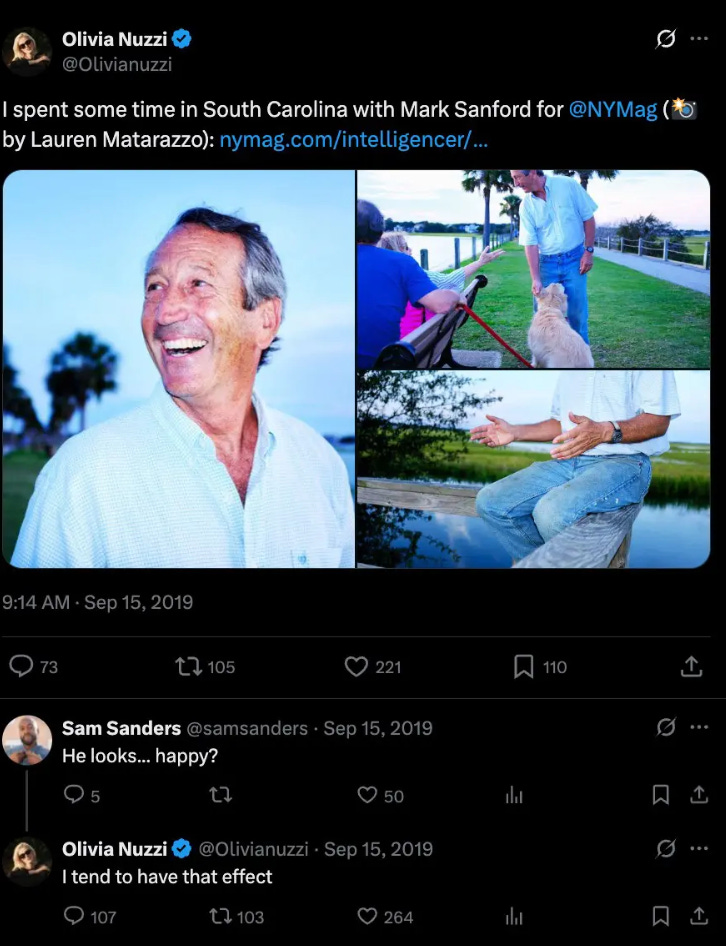
Lizza’s Substack post almost instantly blew up every media-adjacent group chat in the country, and re-ignited the conversation around Nuzzi’s role in the industry. There are mountains of pathos and psychology here, of course. Parts of Nuzzi’s background are equal parts distressing and unbelievable — from her past relationship with Keith Olbermann to her apparent teenage music career, which culminated in a song called “Jailbait” — but none of this really has any bearing on what kind of journalist she is. That can stay in the past: what concerns me is her journalism. You need this context about Nuzzi, I think, to understand how this industry works.
Take, for instance, the most generous interpretation of the past few years of Nuzzi’s career. The RFK affair is true. The Sanford affair is very credibly alleged, by someone who has both personal knowledge of the matter and a pre-existing legal conflict with Nuzzi, meaning that I doubt he would have published such an unequivocal allegation without a pretty solid amount of backup. The details of both of those relationships will most likely be a matter of hearsay until the end of time. But just take it flat out: this is a woman whose job it was to cover the most powerful people on Earth, the people who want power over the very real material conditions of our lives. There is a very real chance that, at some point in the future, elementary school children will die from preventable diseases because the man Olivia Nuzzi was sexting has helped dismantle the CDC’s vaccine mandates for public schools. Do you trust her? Do you want her to be the one that you learn about the world from?
That’s the question at the heart of this. You can fuck up in journalism. Everyone does it eventually. I have made mistakes in stories and pissed off sources and pissed off editors and written words that everyone involved was very embarrassed about. But I like to think that I made these mistakes in good faith. I was not trying to hide who I was or how I felt about who or what I was writing about; I was not trying to mislead my readers into false conclusions under false pretenses. (Nuzzi herself used to be someone who moralized about these things—decrying TV shows that portrayed female reporters sleeping with their subjects and calling out reporters who took selfies with or were overly familiar with sources.)
For what it’s worth, Nuzzi’s sins aren’t plagiarism or fabulism. I don’t think she makes things up, no matter how lurid or cozy her prose gets. But if you clicked on either of the links above and read the profiles of RFK or Mark Sanford, she did lie to you, the reader. She lied to you by omission, and then she lied to her editors about the truth. There is a even a case to be made, morally, for radical honesty—that if Nuzzi had just said that she fucked Mark Sanford while profiling him, I honestly might still trust her. That’d be a hell of a piece, I’m sure, but it’s not what happened.
And still, at least for now, Olivia Nuzzi still has a job in journalism. She has this, I think, largely because she spent many years building these kinds of nebulous relationships with her colleagues and sources and friends. Guiducci, for instance, runs in many of the same circles socially — his partner, New York Times White House correspondent Shawn McCreesh, has been friendly with Nuzzi for years, as they overlapped for a while at New York. One of McCreesh’s buzziest pieces for New York, for instance, was a profile of the crisis comms professional Risa Heller. Heller is now representing Nuzzi during the rollout of American Canto. Small world!
This is how the industry works. Friends do favors for friends. Everyone, largely, looks out for each other, unless they’re stabbing each other in the back. What this creates, thus far, is an environment where fucking up is not a death sentence. You can fuck and cheat and steal, but basically as long as you don’t print something that gets called out as made up, connections and charisma can insulate a career to the point of a black and white New York Times photoshoot one year after it came out that you sent nudes to a presidential candidate. Is this how the industry should work? I don’t think so. I think the only currency that journalists really have is trust and integrity. In that regard, the industry is poorer than it ever has been. The institutions that spent decades upon decades building public trust have been subsumed by a network of influencers spouting payola-funded lies on every possible platform. There are no ethics in new media. There were supposed to be in the old media, in the magazines and newspapers. But look: there’s Nuzzi, still in their pages, in photo and video and print, thanks to her network of friends and lovers. In this new era, trust doesn’t mean shit. I guess we all better start fucking.
She is definitely a person I would've been happy to never hear about again.