

Elon Musk Has Somehow Created a Bad Diner
The Jetsons would be appalled.

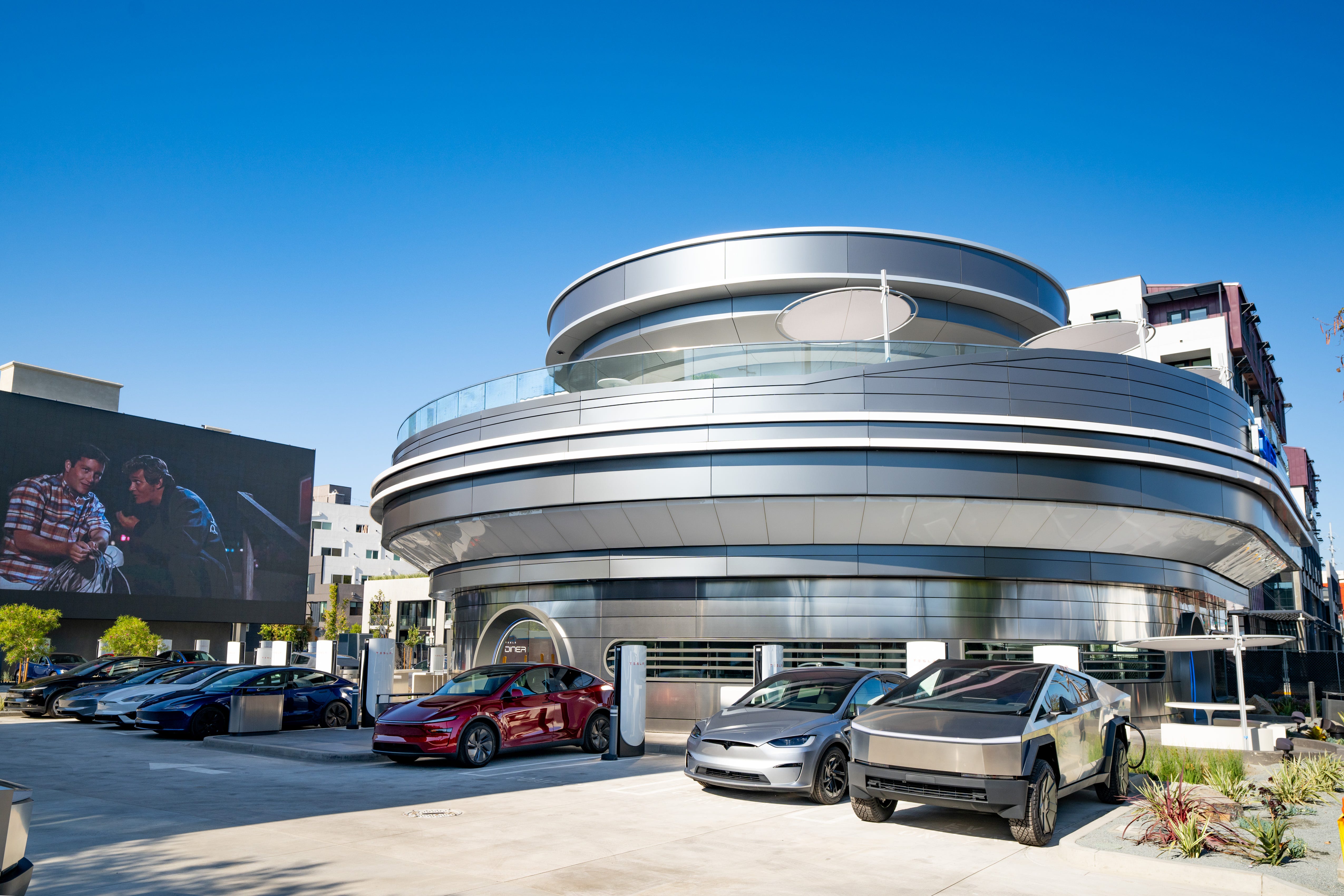
The diner is America’s quintessential restaurant. It is not an original concept—plenty of other countries have roadside or corner cafes that serve wide menus of domestic staple foods—but America, I think, has perfected the form. There is a lot of history and politics wrapped up in the notion of restaurant that seems permanently rooted in the middle of the 20th century—sit-ins during the Civil Rights movement, the dominance of the interstate highway system linking the country and simultaneously killing its chances of ever having a functioning rail network, et cetera—but as anyone who has been hungry and sat down in a plastic-y booth seat and been handed a massive menu and a huge glass of iced water will tell you, diners are good. They have the kind of universal appeal of say, pizza (which they usually do not serve) or hamburgers (which they always do). It is a formula that is pretty hard to fuck up, conceptually: a menu of bland and comforting dishes that can all largely be prepared on the same grill top, seating that often includes booths, some form of pie on the counter. Perhaps a jukebox. That is pretty much all you need. Easy, right?
Well. Not for Elon Musk. The Tesla CEO has created a futuristic interpretation of the diner that appears to be rooted not in a kind of tacky mid-century modernism but in repulsive versions of both the near future and recent past.
Let me explain. Sometime around 2010, the social media website Reddit first started to break out from a niche forum to a mainstream social media empire. Reddit began early enough, in 2005, that its predominant culture was still somewhat rooted in the early 00’s “forum” culture, where users would develop a particular affinity and sense of belonging to a certain website. Now, basically everyone is a “redditor,” in that they passively use or know of Reddit—it is now the 9th most visited website on the internet. But back then, “redditors” still identified as a distinct group. “Reddit meetups” were a very real thing, when the site’s smaller communities would gather to meet each other irl. In this early expansion period, the site’s monoculture came up with a shibboleth for identifying other redditors in the wild, a garbled selection of words that were cultural touchstones on the site at the time. The phrase was, god, I cannot believe I have to type it, “The Narwhal Bacons at Midnight.”
This was all, in hindsight and at the time, incredibly, incredibly embarrassing for those involved. But you have to understand we were at perhaps the internet’s peak cringe era. The rough edges of early forums like 4chan and SomethingAwful had largely been sanded off, and the internet was dominated by a Joss Whedon-core cringe liberalism that loved “quirky” stuff like the Nyan Cat and Marvel movies and electric vehicles and spaceships. You can see where this is going now. This is the internet that created Elon Musk.
I’ve written quite a bit about what it was like to come up in that era, both as a cringe college kid and then a tech reporter in the middle 2010s interfacing with this stuff on a daily basis. But what you need to know is that Elon Musk has really, truly never left this era. His humor is exactly the same. His worldview, transformed as it may seem, is much the same. The optics of his politics are different, but fundamentally, Musk is still the same guy who genuinely found a home in that kind of adolescent internet culture. Everything he does is, in some way, trying to get us back to that point: when he was a hero, when bacon was a meme, when the future looked bright because of his own genius designs. To wit:
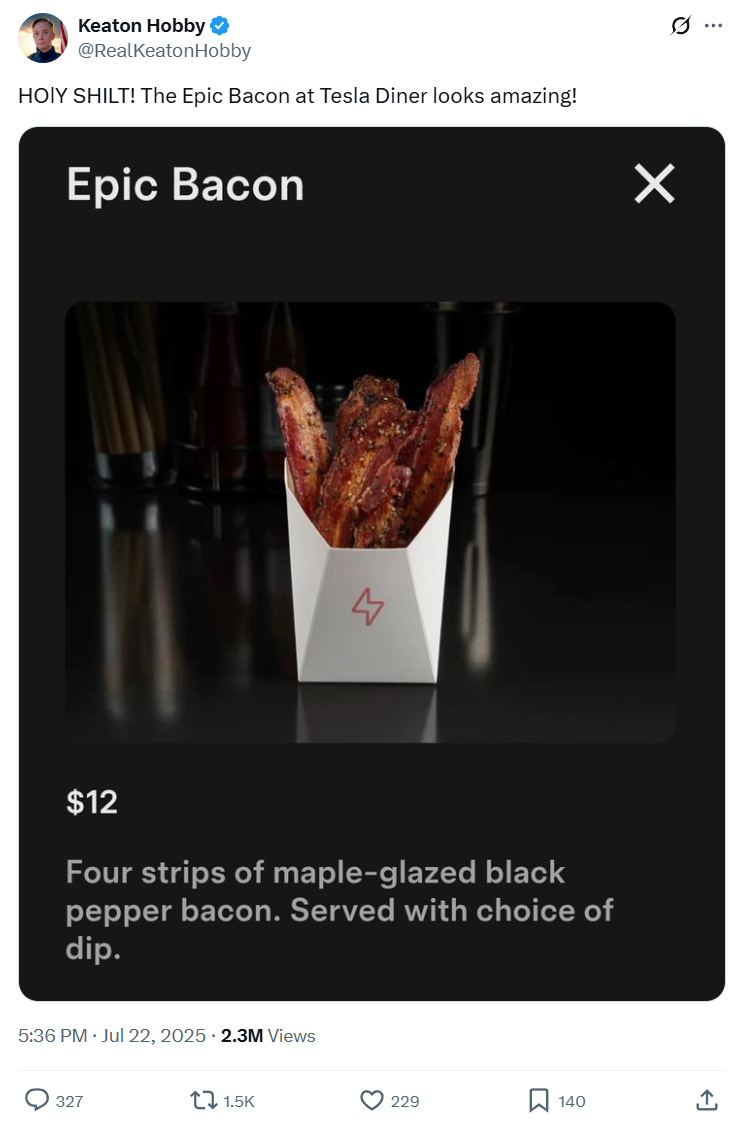
I have not been to Musk’s new Tesla Diner in Hollywood, CA, and so I can’t really review its food. From what I can tell, it is overpriced and underwhelming, a set of conditions that are antithetical to the concept of a diner in general. You’re allowed to have underwhelming food, but that shit better be cheap, in other words. Four strips of bacon for $12 and a $13 hot dog is absolutely not allowed.
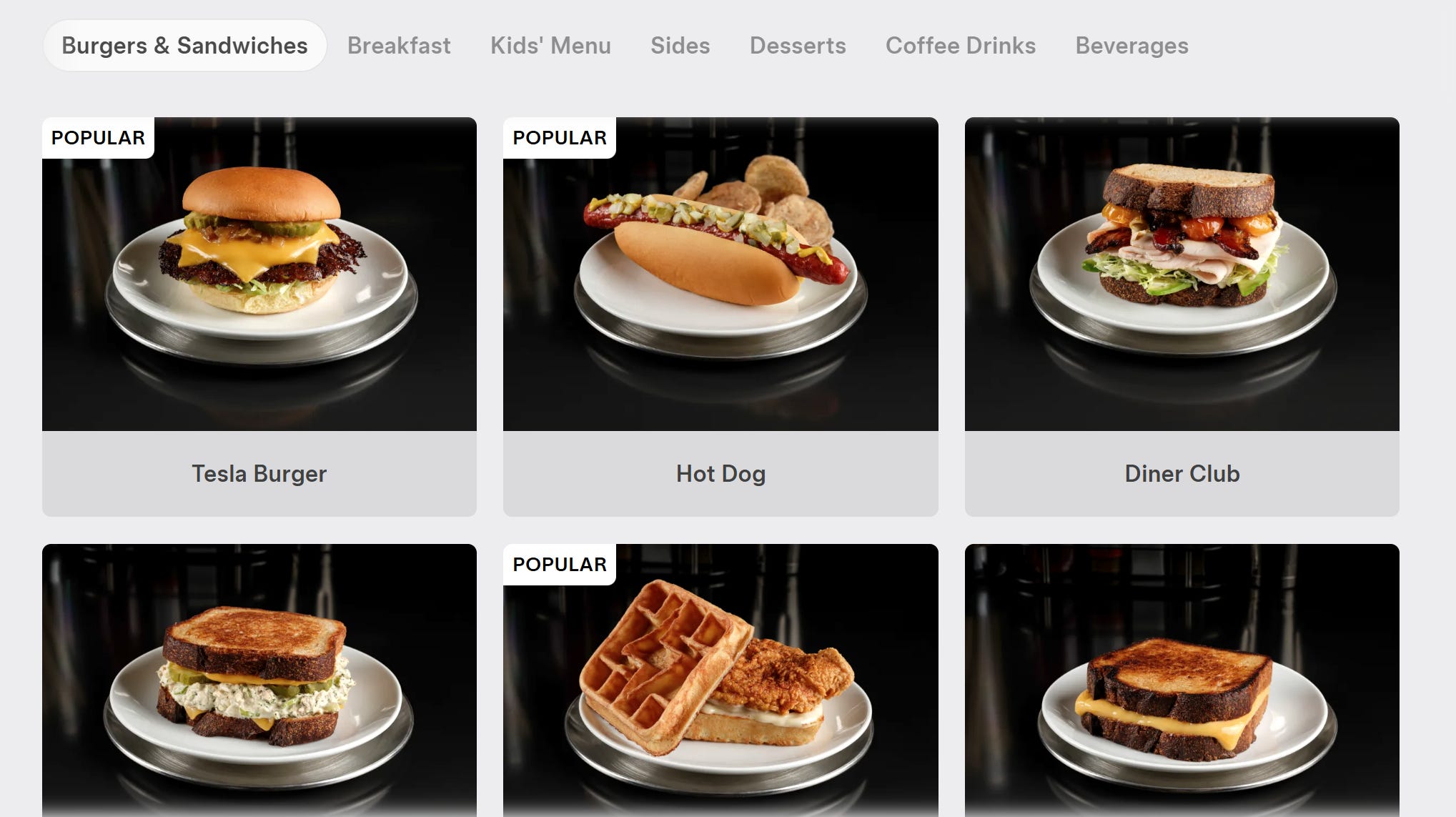
On the restaurant’s website, the food is presented in some austere gunmetal photo booth that makes it seem like a placeholder representation of what food should actually be. There is a common trope in sci fi movies and books, that humans in the future eat less-satisfying simulacrum of real food from our era, as illustrated by a machine that spits out a “CloneSteak” or “FauxMeat” made out of processed nutrients and not real ingredients. This is understood to be a signifier of dystopian futures, not an aspirational standard—and yet. Scroll back up to that picture. Does that grilled cheese look real to you?
Musk himself also made this deeply unappealing promise today:
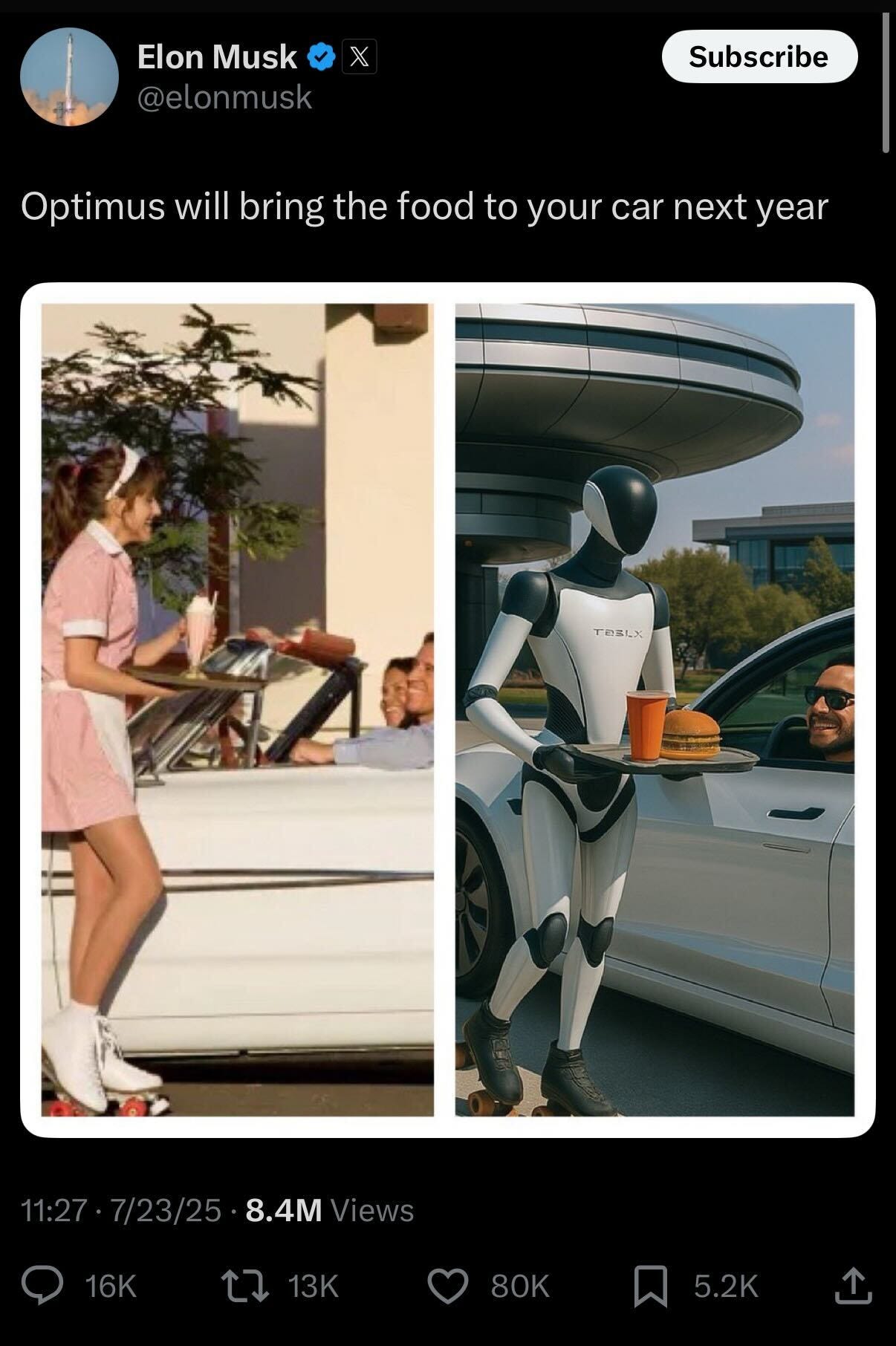
This is not, personally, what I want a diner to be. I do not want to be transported into some slightly-warped version of a future that almost certainly will not exist. A futuristic diner, I hope, would be one that captures and preserves the aesthetic of diners from the past. A real diner, in 2100 or whenever, will likely look much the same as the ones in every town in America, I hope. It won’t be shaped like a flying saucer. It will have bad cheap coffee and sloppily-constructed sandwiches wrapped in wax paper and stuck with toothpicks to hold them together. It will have inexplicably large pancakes that you can really only eat half a stack of. It will have transformative plates of corned beef hash, which you will avoid eating for the first 20 or so years of your life because it sounds gross before giving in and ordering it in a fit of hangover induced lunacy, at which point it will become one of your staples. Corned beef hash is good. A fried egg is good. A diner is a little dysfunctional and a little outdated and always, always familiar. It does not matter what kind of car is parked outside. Elon Musk would know all of that, if he ever spent time in the real world. Instead, we have this: a fantasy created by a man whose soul is still imprisoned by a digital world that has long since past.
To add the horror pile, Musk tweeted, about the carhop comparison photo, “We could put Optimus in a cute outfit too :)"
And as much as I would like to write this off as just another weird, horny Muskism, I think it is emblematic of one of the real problems of current tech culture: that the robots and AI we use to ostensibly minimize labor are highly gendered and used to reinforce the patriarchy.
optimus will definitely NOT be bringing you your food next year